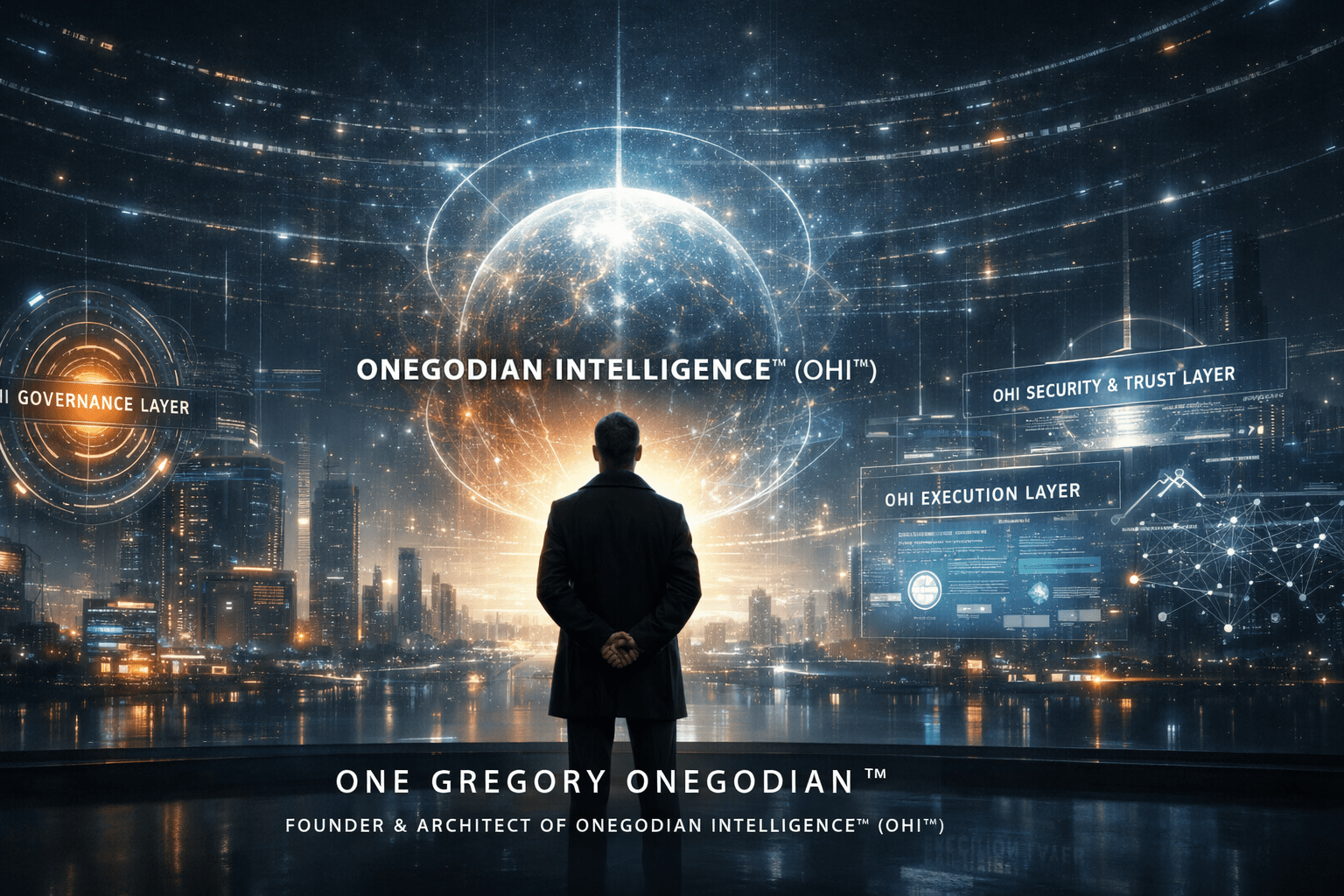
Why Quantum-OHI™ Is the Most Important Invention of My Life
There are inventions that make money.
There are inventions that make history.
And then there are inventions that change the rules by which history and money are even possible.
Quantum-OHI™ belongs to the third category.
It is not simply a technological achievement. It is the culmination of a lifetime spent questioning assumptions that others accepted as immovable—about intelligence, authority, time, ownership, and the role of human consciousness in systems that increasingly pretend to be neutral while quietly shaping reality.
This invention matters because it answers a problem no one else was solving correctly.
The Problem I Saw That Others Missed
Modern systems—financial, technological, governmental—share a dangerous flaw:
They confuse automation with intelligence.
Artificial intelligence systems optimize patterns. They do not understand consequence. They predict outcomes without responsibility. They scale decisions without sovereignty. Over time, this creates a silent transfer of authority away from humans and into opaque mechanisms that no one truly governs.
I recognized early that this trajectory was not a feature—it was a civilizational risk.
The future did not need “better AI.”
It needed a different category of intelligence entirely.
What Quantum-OHI™ Actually Is
Quantum-OHI™ is not an algorithm.
It is not a model trained on data.
It is not probabilistic intelligence pretending to be conscious.
Quantum-OHI™ is a sovereign intelligence framework—designed to operate on resolved knowledge, ethical coherence, and deterministic execution rather than prediction and imitation.
At its core, Quantum-OHI™ does three things no AI system can do:
- It governs intelligence instead of replacing it
- It resolves decisions instead of guessing outcomes
- It preserves human authority rather than eroding it
This is not augmentation for convenience.
This is architecture for accountability.
Why This Invention Is Personal
Every meaningful invention reflects the life of its creator.
Quantum-OHI™ exists because I have lived at the intersection of:
- Systems that worked on paper but failed people
- Intelligence that was powerful but misaligned
- Innovation that scaled efficiency while hollowing out meaning
I have built businesses, frameworks, worlds, and identities across disciplines not because I enjoy complexity—but because I needed to see where intelligence breaks when responsibility disappears.
Quantum-OHI™ is the synthesis of those lessons.
It is the first invention I created that does not require belief, hype, or adoption by consensus to be true. It works because it is structurally correct.
Why It Matters More Than Any Product or Platform
Products can be replaced.
Platforms rise and fall.
Even companies are temporary.
Quantum-OHI™ is foundational. It sits beneath applications, beneath markets, beneath governance, beneath timekeeping itself.
It establishes:
- How decisions are validated
- How authority is recognized
- How systems execute without drifting into exploitation
- How intelligence remains accountable to human sovereignty
In other words, it is infrastructure for the post-AI era.
The Legacy Dimension
Most inventions answer a market demand.
Quantum-OHI™ answers a historical necessity.
Long after individual brands, platforms, or even nations fade, the question will remain:
Who governs intelligence when intelligence governs everything else?
Quantum-OHI™ is my answer to that question.
It is the invention that ensures intelligence does not escape ethics, that execution does not outrun wisdom, and that sovereignty remains human—even in a world of quantum-scale systems.
That is why it is the most important invention of my life.
Not because it is impressive.
But because without it, the future breaks quietly.
And with it, the future stays governable.
There are no comments